Ficha del juego
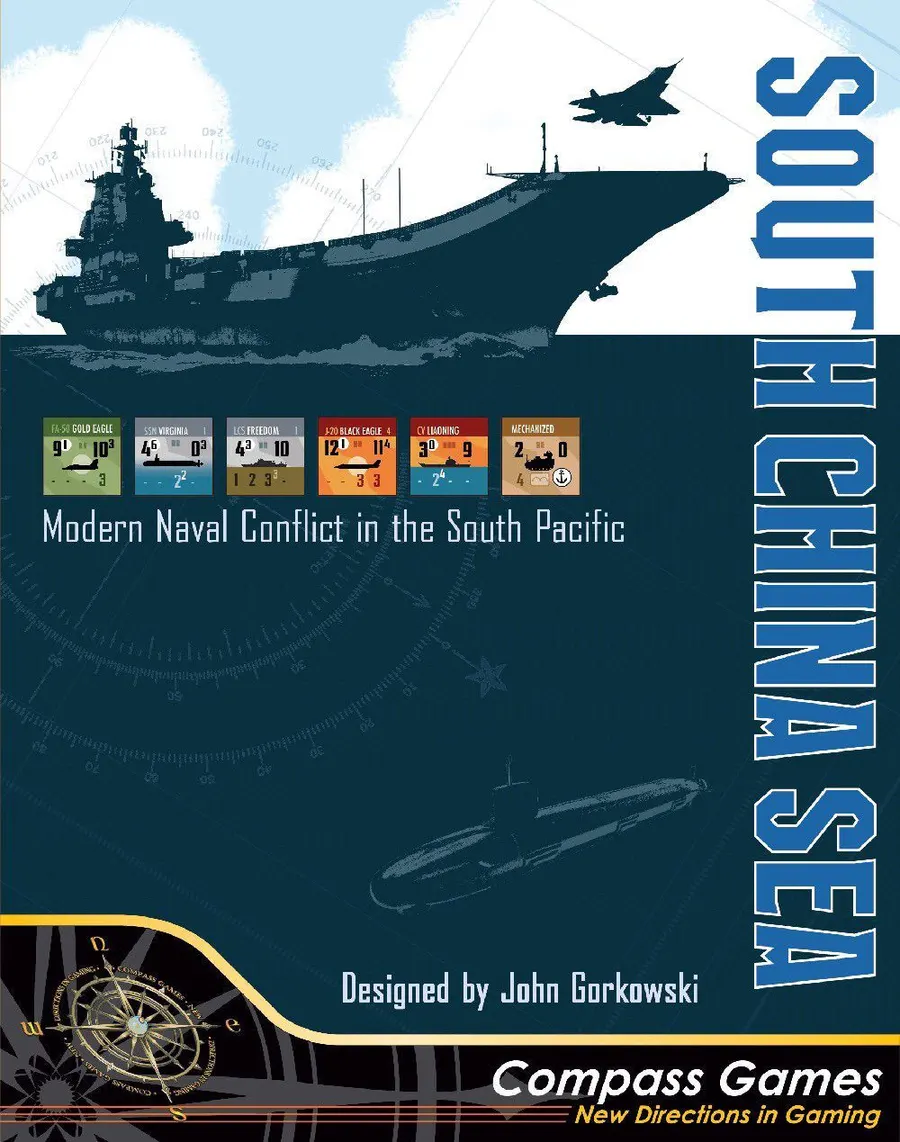
South China Sea: Modern Naval Conflict in the South Pacific
Juego de Político y Negociación para 2–3 jugadores, de 120–240 min y de complejidad media. Se juega con cuadrícula hexagonal, escenarios y campaña y tirada de dados. Recomendado a partir de 11 años. La comunidad de BoardGameGeek lo prefiere a 2 jugadores.
Leer la descripción original de BoardGameGeek (en inglés)
South China Sea (SCS) provides an integrated political-military simulation of near future contention and conflict around the South China Sea. Players take on the roles of China, the United States, Malaysia, the Philippines, and Vietnam. They simulate current political tensions through card play and structured negotiation keyed to real world events in an effort to "move the needle" to their side. Unfortunately, the cards with the greatest chance of moving that needle, such as Chinese Coast Guard and U.S. Freedom of Navigation Exercise, are also most likely to trigger armed conflict. If and when that happens, play transitions to traditional hex-and-counter format on a map scaled at 45 nautical miles (nmi) per hex and turns of 3-7 hours. SCS is derived from Breaking the Chains (BtC), but is definitely a different game. How do the two differ? SCS begins with political turns that can lead to victory without armed conflict. For armed conflict, SCS focuses more closely on the South China Sea (45 nmi per hex) rather than the larger southeast Asian region of BtC (70 nmi per hex) and uses smaller units such as air squadrons, ship pairs, and land battalions. Therefore, the SCS map shows more detail, but less territory. SCS employs streamlined versions of BtC's turn structure and strike mechanisms that expedite play by dispensing with numerous cycles and strike paths. SCS nodded to ergonomics by putting all scores on one side of each counter – less flipping. Most important, SCS allows naval units to move more than one hex in a single turn, but includes a mechanism, based on stealth, that enables the other side to "check" multi-hex moves to create a more dynamic, variable, and volatile environment. This last adjustment allows quick moves at a distance, but prevents close-in ships from "jumping" through the beaten zone of modern anti-ship cruise missiles (ASCM), 290 nmi in some cases. And, every turn has the option for a negotiations phase with some structure to enhance political play if desired.
Diseño de John Gorkowski
Edita Compass Games
Sin edición en español. Solo se encuentra importado y en otro idioma.
Dónde comprarlo
Todavía no hemos encontrado dónde comprarlo.
De este juego no hemos localizado una edición en español a la venta. Guarda la ficha y te la encontrarás enlazada en cuanto aparezca.
Podemos llevarte a los resultados de Amazon para este juego. No prometemos que esté a la venta: es un atajo para mirarlo. Si acabas comprando ahí, Amazon nos paga una comisión y a ti no te cuesta más.
La caja y lo que cuelga de ella
De dónde viene
Reimplementa aBreaking the Chains: War in the South China Sea
Cara a cara
Si te gusta este
Juegos que se le parecen






Opiniones de la comunidad
Reseñas
Todavía no hay reseñas de South China Sea: Modern Naval Conflict in the South Pacific.
¿Lo has jugado? Cuenta qué te pareció y sé la primera persona en reseñarlo.
Ser el primero ↗Los datos de valoración y catálogo se atribuyen a BoardGameGeek (se abre en una pestaña nueva).